

We Can Do Better. Together.
7 commitments to every business manager and member
1. Organizing will be a shared responsibility, and we will communicate openly. The IVP, business managers, organizers, representatives, stewards and members will work together, with quarterly business-manager meetings built for candid discussion, resource-sharing between locals, shared challenges and solutions.
2. The International Vice President will be accessible and accountable to the locals. He works for you. An open-door policy will encourage early communication so issues can be solved together while they are still small.
3. Every local will receive the service and District support it deserves. The District will be properly staffed, with clear points of contact, regular servicing and additional support whenever a local needs it.
4. District staff will have clear responsibilities and manageable workloads. Organizers should be able to organize, servicing representatives should be able to service locals, and staff should not be stretched so thin that the locals suffer.
5. Organizing plans will be built for each local and market - not imposed with a one-size-fits-all approach. Inside, outside, northern and southern New England have different needs; plans will be tailored and updated as conditions change.
6. We will organize workers, work and contractors together - and put District field resources, National Labor Management Cooperation Committee (“NLMCC”) grant support and other national resources where locals have opportunities to grow.
7. We will share successes and failures across all 44 locals. What works will be studied, taught and scaled; what does not work will be discussed openly so every local can learn, adjust and improve.
A stronger Second District starts with organizing, collaboration, and leadership that puts the resources of the IBEW to work for every local.
The International Brotherhood of Electrical Workers is experiencing extraordinary growth. Across the Brotherhood, locals are organizing new members, expanding market share, developing contractors, training organizers, and creating new opportunities for IBEW members.
New England should be part of that growth.
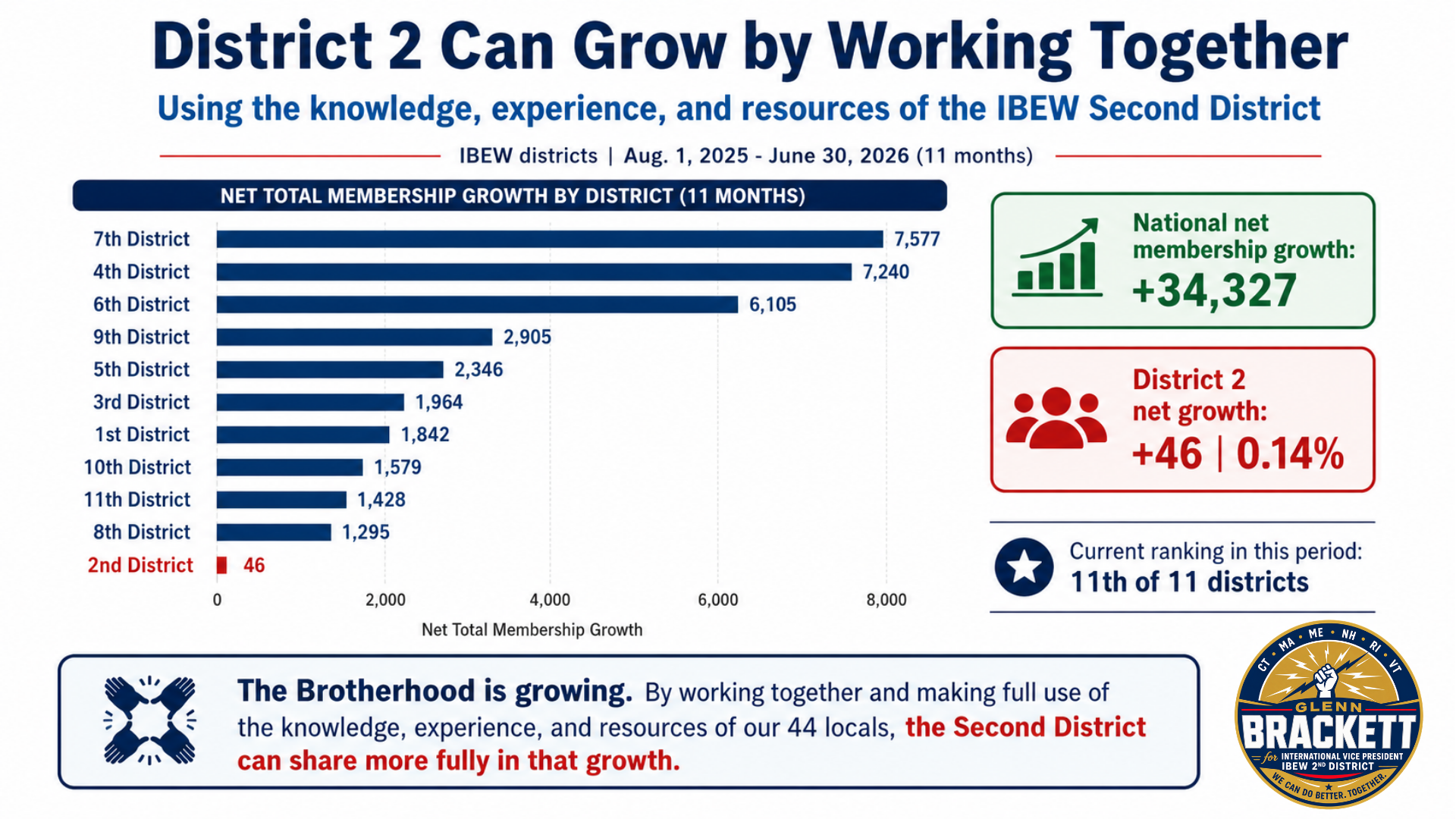
From August 1, 2025 through June 30, 2026, the IBEW added 34,327 net members nationwide — a 4.62% increase. During that same 11-month period, the Second District added just 46 net members, or 0.14%, ranking 11th among the IBEW’s 11 districts in both total and percentage membership growth.
The difference is even more striking in A-membership. While A-membership grew 7.45% across the Brotherhood, the Second District lost 92 A-members — a decline of 0.56% — making it the only IBEW district to post negative A-membership growth during the period.
These numbers are not an indictment of the business managers, organizers, officers, or members of our 44 locals.
They are evidence that the Second District has enormous untapped potential.
Glenn Brackett believes the job of the International Vice President is to help unlock that potential — by connecting locals, sharing resources, investing in organizers, helping business managers solve problems, growing signatory contractors, pursuing every available organizing resource, and helping create more union work throughout New England.
The Brotherhood Is Growing. The Second District Can Grow With It.
Across the IBEW, the evidence is clear: membership growth is possible.
The Seventh District added 7,577 net members during the most recent 11-month period. The Fourth added 7,240. The Sixth added 6,105. Even districts facing different labor markets, geography, industries, and political environments are finding ways to grow.
The Second District added 46.
Glenn does not believe the answer is to point fingers at New England’s local unions. Every jurisdiction is different. Vermont is not Connecticut. Northern New England is not southern New England. Inside construction requires a different strategy than outside construction, utility, telecommunications, manufacturing, or professional and industrial organizing.
The problem is expecting 44 locals to solve every challenge on their own.
The District Office should be the place where knowledge is shared, successful ideas are scaled, problems are solved early, and resources are moved to the places where they can make the greatest difference.
Under Glenn’s leadership, the Second District will work as a district.
A-Membership Is Driving IBEW Growth — and Represents a Major Opportunity for New England
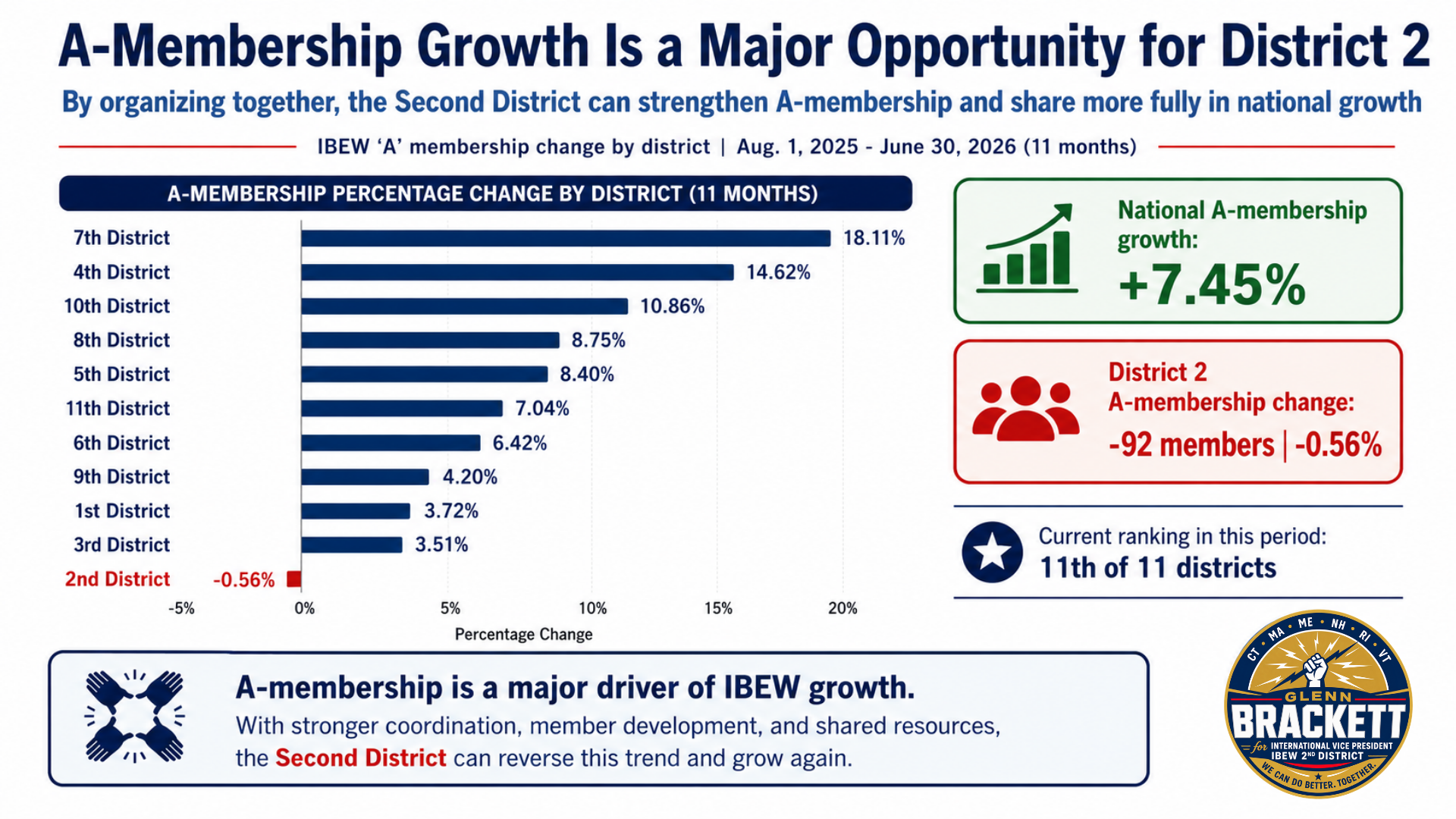
The national growth story is being driven in large part by A-membership.
From July 2021 through June 2026, IBEW A-membership increased by more than 100,000 members — approximately 24.6%.
In the most recent 11-month reporting period alone, A-membership increased 7.45% nationally.
Meanwhile, the Second District declined 0.56%.
For Glenn, that is not a reason to write New England off.
It is a reason to organize.
The Second District has talented organizers, experienced business managers, skilled members, outstanding training programs, and strong local unions. What it needs is District leadership committed to connecting those assets into one coordinated growth strategy.
That means identifying where the next members will come from, training the people who will organize them, tracking prospects and results, aggressively recruiting experienced electrical workers, expanding apprenticeship pipelines, organizing contractors alongside workers, and helping every local develop a strategy tailored to its own market.
The Opportunity Is Growing Every Year
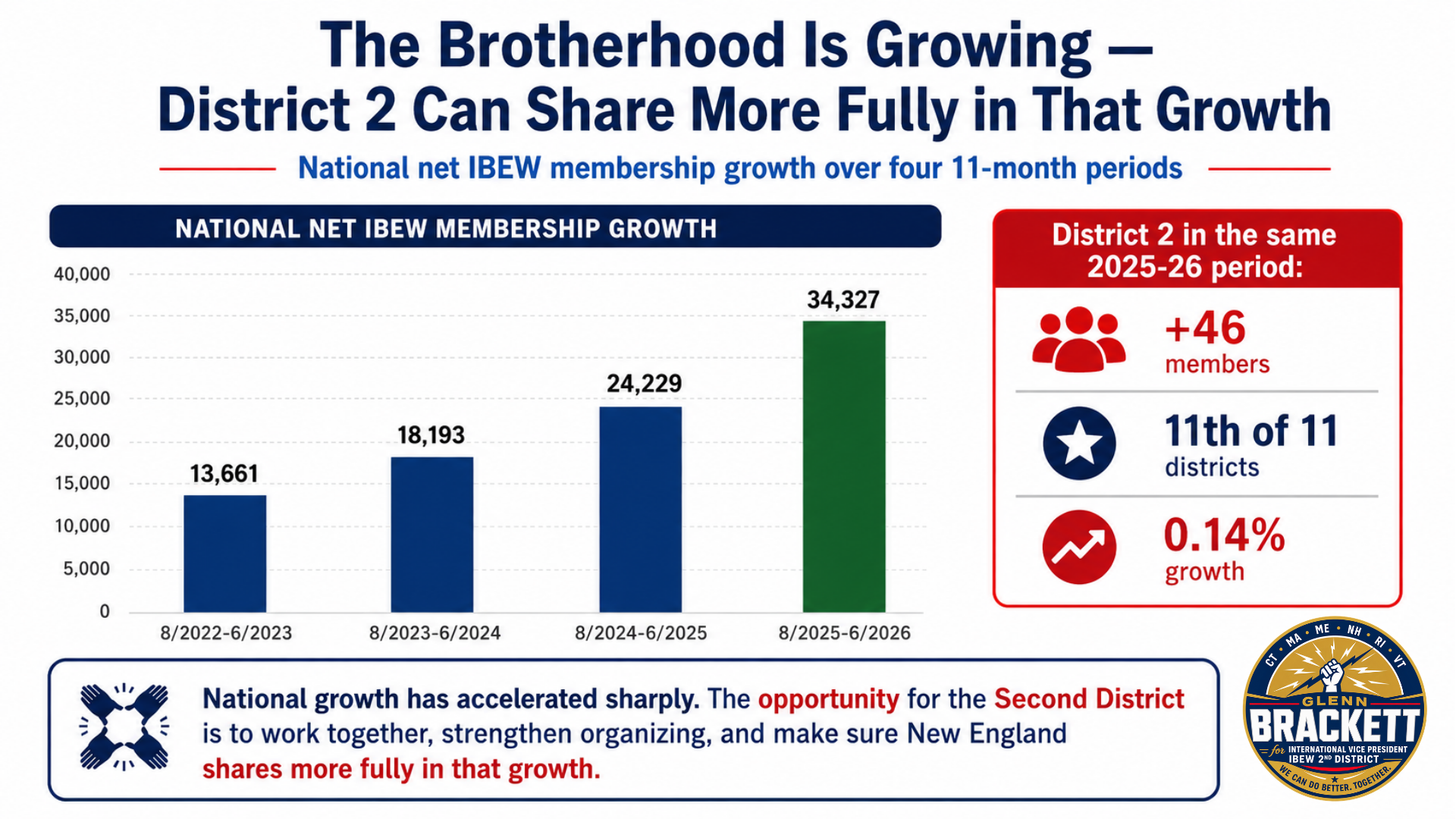
The Brotherhood’s growth is not slowing down.
It is accelerating.
Over comparable 11-month periods, national net membership growth rose from 13,661 in 2022–23, to 18,193, to 24,229, and then to 34,327 in 2025–26.
That is why this moment matters.
The question facing the Second District is not whether the IBEW can grow.
We already know it can.
The question is whether New England will have District leadership willing to study what is working elsewhere in the Brotherhood, invest in the people doing the organizing, adapt those strategies to our six states, and make growth a measurable priority.
Glenn Brackett is running for International Vice President because he believes we can do better — and that we can do it together.
Glenn Brackett Has Spent His Career Bringing People Together
Glenn’s organizing philosophy did not begin with this campaign.
It comes from more than four decades in the labor movement.
Glenn joined IBEW Local 2320 as a young telecommunications worker and became a steward at just 23 years old. He eventually served for more than a decade as Business Manager of IBEW Local 2320, representing members through enormous changes in the telecommunications industry.
As Business Manager, Glenn learned what it means to be responsible for a local union: negotiating contracts, protecting jobs, representing members, managing resources, dealing with employers, and making difficult decisions when people's livelihoods are on the line.
That experience was tested during the historic FairPoint Communications dispute. Glenn helped lead Local 2320 through a 131-day strike, part of a regional fight involving more than 1,700 IBEW and CWA members across New Hampshire, Maine, and Vermont. The eventual agreement restored important retirement and health-care protections and preserved job-security provisions against outsourcing.
That fight also shaped Glenn’s view of leadership.
He saw firsthand what happens when individual locals stop operating as islands and instead bring members, unions, communities, elected officials, and allies together around a common purpose.
When Glenn became President of the New Hampshire AFL-CIO in 2015, he said his first responsibility would be to grow good jobs, work with businesses and apprenticeship programs, listen to affiliated local unions, and build relationships rather than burn bridges.
That is the same philosophy he would bring to the Second District.
Proven Leadership in Building Coalitions
Leading an IBEW district requires more than running meetings.
It requires the ability to bring people with different interests, personalities, jurisdictions, and political views together and get results.
Glenn has done that for more than a decade as President of the New Hampshire AFL-CIO.
New Hampshire has repeatedly considered so-called “Right-to-Work” legislation under legislatures controlled by both parties. Under Glenn’s leadership, labor has helped build bipartisan coalitions to defeat those attacks again and again.
In 2025, the challenge was especially difficult. Glenn described labor as beginning the fight 44 votes behind. The final vote defeated Right-to-Work by 20 votes. IBEW itself credited the Brotherhood’s locals and members with helping carry that effort.
That did not happen because everyone agreed politically.
It happened because Glenn understands how to listen, build relationships, find common ground, communicate across differences, and keep people focused on the goal.
He has brought that same approach to relationships with business and community leaders and with elected officials at the state and federal level, including Senators Jeanne Shaheen and Maggie Hassan, Congressman Chris Pappas, Congresswoman Maggie Goodlander, and lawmakers from both political parties.
His work alongside Congressman Pappas on the PRO Act and Congresswoman Goodlander in support of workers’ organizing rights is publicly documented, as is his long record of building bipartisan support for labor priorities.
Glenn has even demonstrated a willingness to work with organizations traditionally on the opposite side of labor debates when there is an opportunity to accomplish something important — including partnering with a free-market policy organization on reforms designed to save taxpayers and workers money.
That ability to build coalitions is exactly what the Second District needs.
The District Office Should Work for the Locals
Glenn believes an International Vice President should never forget who he works for:
the local unions of the Second District.
Business managers should be able to talk candidly with one another and with their IVP. Problems should be addressed while they are small rather than allowed to become crises. Locals should know who is servicing them, when they will see their representatives, and where to go when they need help.
The District should be properly staffed, and staff members should have clearly defined responsibilities so organizers can organize, servicing representatives can service locals, and no one is spread so thin that the locals suffer.
Most importantly, one size does not fit all.
Every local deserves an organizing and growth strategy based on its jurisdiction, its membership, its industries, its contractors, its market share, and its opportunities.
And when something works?
Share it.
When something fails?
Share that too.
There is something to learn from both.
Forty-four locals should not have to make the same mistake 44 times — or independently rediscover the same successful idea 44 times.
Learn From the IBEW Districts That Are Getting Results
Glenn’s plan is not built around pretending the Second District needs to invent organizing from scratch.
Some of the best ideas already exist inside our Brotherhood.
The First District has demonstrated how District leadership can establish organizing targets, build dedicated field capacity, pursue contractors, conduct regular organizing audits, and coordinate locals around a common strategy.
The Ninth District has demonstrated how to build a culture of organizing through Member-to-Member training, Organizing Stewards, repeated field experience, mentorship, and a leadership pipeline that turns rank-and-file activists into future organizers and union leaders.
The Sixth District has demonstrated the value of treating organizing as a professional craft, including intensive Organizer Boot Camp training, labor-law education, experienced mentors, continuing education, and specialized organizing infrastructure.
Glenn’s approach is straightforward:
Take the best ideas in the IBEW, bring them home to New England, and adapt them to the needs of our locals.
Glenn’s Organizing & Growth Plan for the Second District
Glenn’s full Second District Organizing & Membership Growth Plan lays out a practical roadmap for turning these ideas into action.
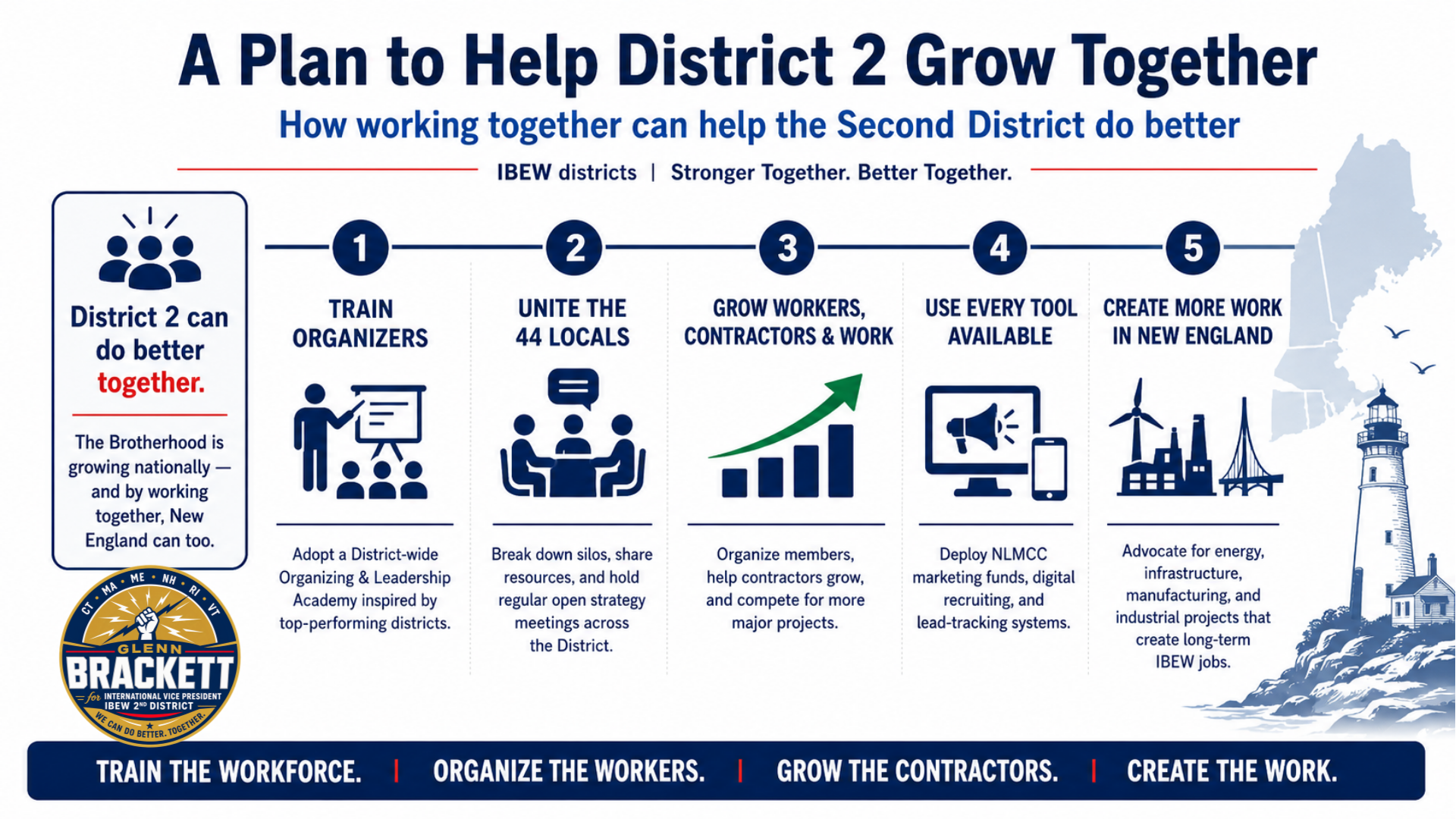
At its core are five priorities:
Train the workforce and the organizers. Build a Second District Organizing & Leadership Academy, create rank-and-file Organizing Stewards, and establish an intensive professional Organizer Boot Camp so organizing is treated like the skilled craft it is.
Unite and serve the 44 locals. Break down silos, hold regular business-manager strategy meetings, establish an open-door District Office, properly staff servicing responsibilities, and create market-specific local growth plans.
Grow workers, contractors, and work together. Recruit experienced electricians, strengthen apprenticeship pipelines, develop signatory contractors, help members become union contractors, and pursue new markets.
Use every resource available to us. Put NLMCC advertising and recruitment resources to work, strengthen digital organizing, build better worker and contractor data, respond rapidly to organizing leads, and measure what produces results.
Create more work in New England. Use the relationships of the District Office to advocate for energy, infrastructure, manufacturing, advanced nuclear, transmission, and other major projects capable of creating long-term IBEW careers.
The philosophy can be summed up simply:
Train the workforce. Organize the workers. Grow the contractors. Create the work.
Organizing the Work Means Helping Create the Work
Glenn also understands something that the numbers alone cannot capture:
New England is not Texas, Arizona, or Ohio.
Our region faces different economic conditions, including high electricity costs that can make it harder to attract the energy-intensive industrial, manufacturing, data-center, and infrastructure investments producing thousands of electrical jobs elsewhere.
That reality should not become an excuse.
It should become part of the strategy.
A growth-focused Second District should be at the table with utilities, employers, developers, signatory contractors, Building Trades partners, and policymakers before major project decisions are made.
That includes supporting reliable and affordable new generation, transmission infrastructure, advanced manufacturing, and exploring advanced nuclear and small modular reactor opportunities where projects are safe, economically viable, and appropriately approved.
The job of an IVP should not simply be to organize whatever work happens to arrive.
It should also be to help bring more work home to New England.
Why Glenn BRACKETT?
The Second District does not lack talent.
It does not lack committed business managers.
It does not lack skilled organizers.
And it certainly does not lack great IBEW members.
What it needs is leadership capable of bringing all of those strengths together.
Glenn Brackett has spent his career doing exactly that.
As a Business Manager, he understands the pressures local leaders face because he has sat in their chair.
As an IBEW member and labor leader, he understands the importance of organizing because he has spent his career fighting to protect and expand good union jobs.
As President of the New Hampshire AFL-CIO, he has spent more than a decade bringing unions together, building bipartisan coalitions, working with businesses and elected officials, defending collective bargaining, and making sure working people have a seat at the table.
And as International Vice President, Glenn will bring that same approach to all six New England states:
Listen to the locals. Connect their strengths. Share their resources. Train their people. Solve problems together. Measure the results. And never stop looking for the next opportunity to grow the Brotherhood.
We Can Do Better. Together.
The Brotherhood is growing.
The talent exists within the Second District.
The resources exist within the IBEW.
The opportunity is in front of us.
It is time to put all of them to work.
44 Locals. 6 States. 1 Organizing Mission.
Build the Brotherhood. Grow market share. Create more union work. Give every local the tools to organize and win.